Paris

By Marco Bellini
Giverny is 80 km northwest of Paris in the Seine Valley, about 45 minutes by train from Gare Saint-Lazare to Vernon, then a short shuttle or bike ride to Monet's house and garden. The water garden with its Japanese bridge and water lilies is the single most photographed private garden in France. It is open from late March to early November, and every visitor who has seen it will tell you to go early.
Giverny is a small village, the Monet Foundation (house + garden) is the entire reason visitors make the trip. The train from Gare Saint-Lazare to Vernon is direct and takes about 45 minutes. From Vernon station, a shuttle bus runs to the Monet Foundation entrance (about 15 minutes, €10 return). The logistics are manageable independently. The case for a guided tour is specific: you want someone to explain Monet's painting spots along the Seine on the drive out, the garden's planting schedule and restoration history while you are inside, and skip-the-line entry during peak summer weeks when the queue at the gate can exceed an hour.
Giverny is compact, you are visiting one garden, one house, and one village. The tour quality depends on the guide, the transport comfort, and whether skip-the-line entry is included during peak season.
Giverny is one attraction, the Monet Foundation, inside a small Normandy village of about 500 residents. The visit has two distinct parts: the house and the garden, connected by a tunnel under the D5 road.
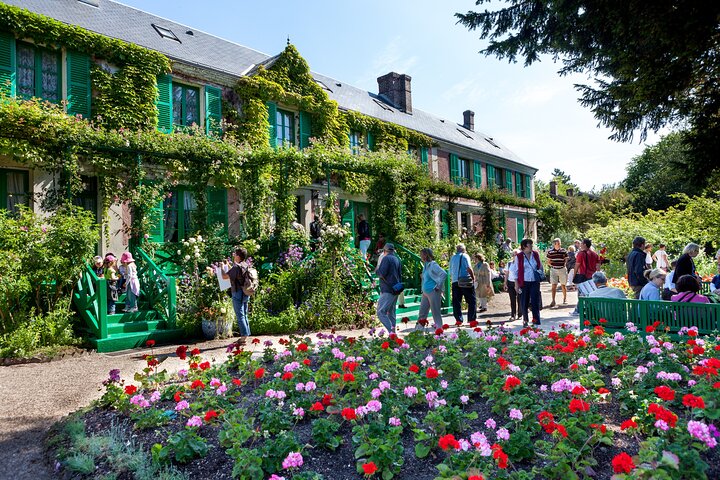
The pink stucco house where Monet lived from 1883 until his death in 1926. Inside: the famous yellow dining room, the blue-tiled kitchen with its copper pans, Monet's first-floor bedroom with views over the garden, and his collection of Japanese woodblock prints (Hokusai, Hiroshige) displayed on the walls. The house interior takes about 30–40 minutes, the rooms are on two floors and the tour route is one-way. I spent longer in the dining room than I expected, the yellow walls against the blue-and-white Rouen ceramics make the room feel warm even on an overcast Normandy morning.
The water garden is across the road from the house, connected by a pedestrian tunnel. This is the garden Monet designed and painted for 30 years, the Japanese bridge covered in wisteria, the water lilies pond, the weeping willows, and the bamboo grove. The bridge is the single most recognisable feature and was painted by Monet in 17 of his water lily canvases. The water garden is at its peak from mid-June through early September when the lilies are in full bloom.
A small museum 300 metres from Monet's garden that runs rotating exhibitions on the Impressionist movement. It is not part of the Monet Foundation (separate ticket, about €9) but is a natural add-on if you have made the trip to Giverny. The museum is well-organised and covers artists beyond Monet, Pissarro, Caillebotte, and the American Impressionists who worked in Giverny's artist colony in the early 1900s. Budget 45–60 minutes.
Giverny village is small, one main road (Rue Claude Monet), a handful of restaurants and cafés, the Hôtel Baudy (where Cézanne, Rodin, and Mary Cassatt stayed while visiting Monet), and the Église Sainte-Radegonde where Monet is buried in the churchyard. You can walk the entire village in 20 minutes. The restaurants fill up by midday during peak season, booking ahead is essential in July and August if you want a sit-down lunch rather than a crêpe from a roadside stand.
Giverny is a garden with a house attached. If that description does not appeal to you, this is not the day trip you are looking for.
Skip the guided tour if: you are comfortable taking a French regional train, navigating a shuttle bus, and do not need a guide to appreciate a garden. The train from Saint-Lazare to Vernon runs roughly hourly, the logistics are not difficult. You will save about €20–40 per person compared to the cheapest half-day tour, which you can put toward lunch in the village. The trade-off is that you will not get the artistic commentary, the skip-the-line priority on busy summer mornings, or the convenience of door-to-door transport from your Paris hotel.
Skip Giverny if: you are visiting Paris between November and March, the garden is closed. Even in April and October, the garden is open but the flowers are sparse and the water lilies will not be blooming. If you want a garden day trip in the off-season, consider Versailles Choose this if: You want a guided experience with transport and logistics handled so you can focus on the sights. Skip if: You prefer setting your own pace and itinerary without being tied to a group schedule. instead, the palace interior and formal gardens are impressive year-round and not dependent on seasonal blooms.
Skip the Versailles combo if: you want to properly see either destination. The combo tours cover roughly 200 km of driving, with about 2 hours at Versailles in the morning and 1.5–2 hours at Giverny in the afternoon. You are seeing both at a sprint. This works if you have exactly one free day in Paris and want to tick both boxes, but a dedicated half-day at each is a better experience.
Day trips from Paris require planning – train schedules, opening hours, and seasonal closures. If you are willing to do the logistics homework, these are some of the best day trips in Europe.
Is Giverny worth a day trip from Paris?
How do I get from Paris to Giverny by train?
When is the best time to visit Monet's garden?
Can I combine Giverny with Versailles in one day?
How long do I need at Monet's garden?
Is Giverny crowded?
🛈 This page contains affiliate links to Viator. We may earn a commission if you book through these links — at no extra cost to you.